Your Parent Just Got Home From the Hospital and There's Nothing in the Fridge. Here's What to Do When They Still Say No.
Picture the scene: your mother has just been discharged after several days in the hospital, and you drive her home to find an empty refrigerator, a sink full of dishes, no clean laundry, and a house that nobody has tidied in over a week. She is weak, she is moving carefully, and she is absolutely certain she does not need anyone's help. "I'm fine," she says. "I don't want a stranger in my house." And then you go back to your own home, your own children, your own job, and you spend the next several days wondering whether she's actually eating anything.
We see this situation more often than almost any other. It is not unique to one family or one kind of patient. And I want to say clearly: your mother is not being irrational, and your family is not failing her by feeling stuck. What you are both dealing with are two very real and very understandable beliefs, and neither one of them is answered by simply arguing harder.
The Two Beliefs That Block Help After a Hospital Discharge
The first is what I call stranger anxiety. When someone is physically vulnerable, not fully recovered, and not able to take care of themselves the way they normally would, the idea of having a person they do not know come into their home feels like a loss of dignity on top of an already difficult situation. You are not just tired and weak; you are also in a private space, and now someone you have never met is going to see all of that. That is a real feeling, and it deserves to be treated as one.
The second belief is simpler to name and harder to shift: "I can still manage." After a hospitalization, the body is genuinely deconditioned. Strength, balance, and stamina are all lower than they were before admission, sometimes significantly lower. But the patient's mind is often still running on the assumption that they are the person they were two weeks ago. They believe they can get up, make a meal, get to the bathroom safely, and manage their medications correctly. Sometimes they can. Very often, they cannot, and the gap between what they believe and what is actually happening at home is where falls, missed medications, and malnutrition take hold.
Falls are the number one risk of death for older adults, and a fall in a weakened, recently discharged patient is a real possibility, not an abstract one. Prevention is better than cure, and the window right after a hospital stay is exactly when prevention matters most.
What Families Fear, Too, and Why That's Worth Naming
I also want to say something directly to the adult children in this situation, because the resistance does not always come only from the patient. Some families hesitate to bring in a home health aide because they worry: what if someone comes into the house and takes something? What if we let in a stranger and that turns out to be a mistake? That fear is legitimate. It is also one of the reasons we exist as a licensed agency rather than simply a referral service or a private arrangement.
Every home health aide and personal care aide who works with us goes through a criminal background check and a CHRC clearance (that is a Health Research, Inc. background check required by New York State) before they ever enter a patient's home. Every aide completes a 40-hour Personal Care Aide certification course taught by a licensed registered nurse. We carry liability insurance. We are licensed by the New York State Department of Health, which is one of the most heavily regulated licensing environments in the country, and we operate fully by the books. When you bring someone in through Surrogate Family Care, you are not hiring off a message board or hoping for the best. There is a documented, supervised team behind that aide, and our clinical staff is following the case.
Not everybody is bad. Please give a chance. But give it through a structure where someone is accountable.
In-Home Physician Care
Same-day urgent care appointments, in the home
Home-based physician visits for older adults and veterans. Call and get a same-day appointment. Serving NYC, Nassau, Suffolk, Westchester, Putnam, and Duchess counties.
| Request a Home Visit | or call (516) 806-2223 |
How We Actually Build Trust With a Patient Who Said No
What we have learned over hundreds of patients is that the answer to stranger anxiety is not persuasion; it is familiarity built carefully over time. We try to send a consistent caregiver, the same face as much as possible, so that the patient is not meeting someone new every shift. Our team checks in with the family regularly, not just when something goes wrong, so that you as the adult child or the family caregiver are not left wondering. If our aide notices that a patient is not eating well, that a medication does not seem to be getting taken correctly, or that something about the patient's condition looks different, they escalate to our clinical team. We work as an extended family in that sense: watching, reporting, following up, so that the family who cannot be there every day does not have to carry all of that uncertainty alone.
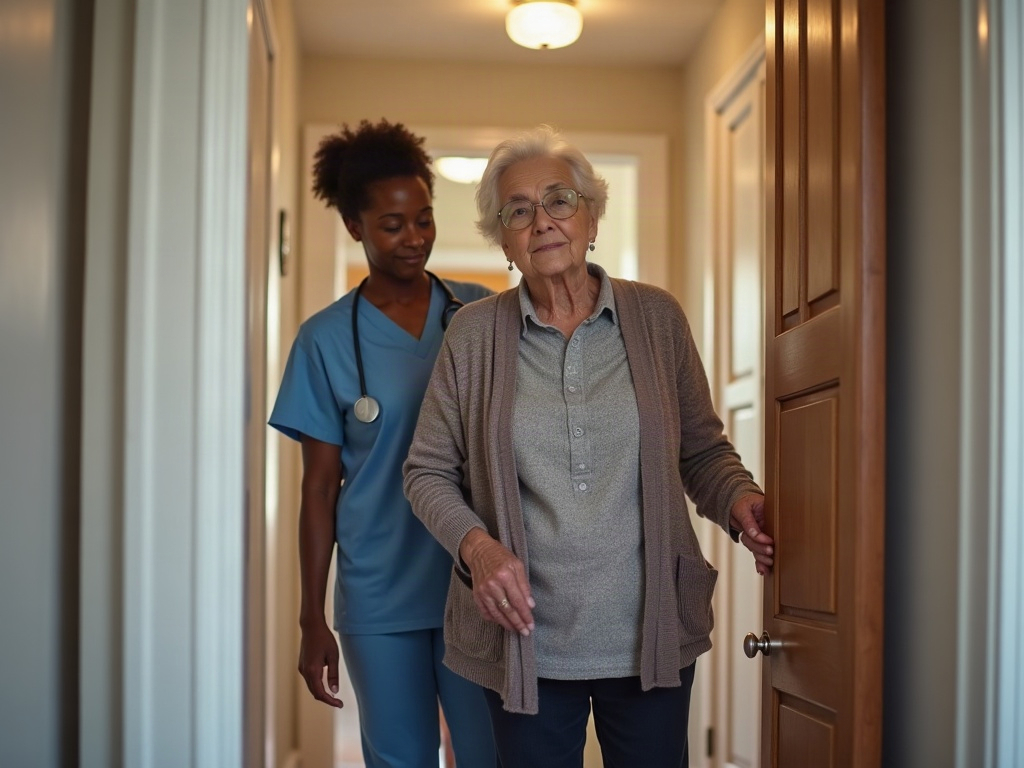
On the therapeutic side, we can also bring in skilled nursing visits, physical therapy, and occupational therapy directly at home, which means the patient does not have to travel anywhere to continue recovering safely. A physical therapist working in the actual home environment can assess fall risks that would never show up in a clinic, including throw rugs, poor lighting, furniture that the patient grabs for balance without realizing it, and thresholds that become obstacles when someone is not yet steady on their feet.
Respecting the Right to Decide While Reducing the Risk of Waiting
I am not in the business of overriding a patient's decision. Your mother has the right to say no. But I do think she, and you as her family, deserve to make that decision with full information rather than just the fear of strangers on one side and nothing on the other. What I would ask any resistant patient or hesitant family to consider is this: the first visit does not have to be a commitment. It does not have to mean losing control of the house or giving up independence. It can be a single aide coming in a few days a week to help with meals, light housekeeping, and a companion for a few hours, while the patient retains every other part of their routine exactly as it was.
The goal is always to keep people at home, in their own space, on their own terms, for as long as safely possible. That is why we built Surrogate Family Care the way we did: one agency, one team, non-clinical support and skilled clinical care together, so that whatever your parent needs right now, and whatever they need six months from now, does not require starting over with someone new.
If your parent has recently come home from the hospital and you are trying to figure out where to start, we serve all five boroughs of New York City, Long Island, and Westchester, Putnam, and Dutchess counties. Reach out to us to talk through what a home care evaluation looks like and what level of support actually fits the situation. You do not have to have this figured out before you call.
Surrogate Family Care
Premal Jani, MD
(516) 806-2223
What is the difference between a home health aide from a licensed agency and someone hired privately?
When you hire privately, you are the employer, and there is typically no background check, no certification requirement, and no one supervising the arrangement. If something goes wrong, there is no clinical team to escalate to and often no liability coverage. When you work with a licensed home health agency like Surrogate Family Care, every aide has completed a criminal background check, a CHRC clearance required by New York State, and a 40-hour certification course taught by a licensed registered nurse. The aide is backed by a clinical team that is monitoring the case and following up. That supervision structure is what makes the difference between hoping someone is trustworthy and actually knowing there is accountability in place.
What does a home health aide actually do for someone who just got out of the hospital?
At the non-clinical level, a home health aide or personal care aide can help with activities of daily living (things like dressing, bathing, and grooming), meal preparation, light housekeeping, medication reminders, and companionship. For patients who need clinical support as well, we can coordinate skilled nursing visits, physical therapy, occupational therapy, and speech therapy directly at home. Physical therapy in the home is particularly valuable right after a hospitalization because the therapist can assess real fall risks in the actual environment the patient is living in, not a clinic setting, and work on strength and balance where it matters most.
My parent lives alone and refuses to call anyone for help. What can I do from across town?
This is one of the most common situations we work with, and it is genuinely hard on both sides. What we can offer the family is a team that watches and communicates, so you are not left waiting for a phone call that may or may not come. Our aides and clinical staff flag changes they observe, and we reach out to the family regularly rather than only in a crisis. If a situation escalates beyond what home care can address, we know how to connect patients with social workers, Adult Protective Services, and Elder Protective Services. You do not have to manage this alone from a distance, and your parent does not have to be in immediate danger for it to be appropriate to ask for a home evaluation.
Next Step
Request In-Home Care Services
Homemaking, personal care, companion care, skilled nursing, therapeutic services, and home-based physician visits. Serving NYC, Nassau, Suffolk, Westchester, Putnam, and Duchess counties.
| Request Services | or call (516) 806-2223 |